
VSEPR Worksheet with Answers PDF: A Comprehensive Guide
Numerous online resources offer VSEPR worksheet solutions in PDF format, aiding students in mastering molecular geometry predictions. These guides utilize the Valence Shell Electron Pair Repulsion (VSEPR) theory, focusing on electron pair arrangements and molecular shapes.
Many examples, like those involving water (H₂O), ammonia (NH₃), and carbon dioxide (CO₂), are included, alongside explanations of ABE notation and polyatomic ion structures like ammonium (NH₄⁺).
These worksheets help practice determining electron pair and molecular geometries, understanding bond angles, and applying the VSEPR model to various compounds.
VSEPR, short for Valence Shell Electron Pair Repulsion theory, is a foundational concept in chemistry used to predict the shapes of molecules. This theory posits that electron pairs surrounding a central atom repel each other, and arrange themselves to minimize this repulsion, dictating the molecule’s geometry. Understanding VSEPR is crucial for visualizing three-dimensional molecular structures, which directly impacts a molecule’s physical and chemical properties.
VSEPR worksheets, often available in PDF format, serve as invaluable tools for students learning this theory. They provide structured practice in applying the principles of VSEPR to various molecules, reinforcing the connection between electron arrangement and molecular shape. These resources typically include examples ranging from simple diatomic molecules to more complex polyatomic ions, like ammonium (NH₄⁺), allowing for a comprehensive grasp of the concepts.
The core idea revolves around minimizing electron pair repulsion, leading to specific geometries like linear, trigonal planar, and tetrahedral. Mastering VSEPR is essential for predicting reactivity, polarity, and other important molecular characteristics.
What is VSEPR? (Valence Shell Electron Pair Repulsion)
VSEPR, or Valence Shell Electron Pair Repulsion, is a model in chemistry that explains the geometry of molecules based on the repulsion between electron pairs in the valence shell of a central atom. These electron pairs – both bonding and lone pairs – arrange themselves to maximize distance, minimizing repulsive forces. This arrangement directly determines the molecule’s shape.
VSEPR worksheets, frequently found as PDF downloads, are designed to help students apply this principle. They present molecules and ask learners to predict their shapes based on the number of electron groups around the central atom. The theory acknowledges that lone pairs exert a greater repulsive force than bonding pairs, influencing bond angles and overall geometry.
Understanding VSEPR is fundamental to predicting molecular properties. Practice with worksheets, including those with provided answer keys, solidifies this understanding and builds confidence in applying the model to diverse chemical structures.
The ABE Notation System
The ABE notation is a shorthand used within VSEPR theory to classify molecules based on the number of atoms bonded to the central atom (A), the number of lone pairs on the central atom (E), and the total number of bonded atoms (B). This system simplifies predicting molecular geometry, a key skill reinforced by VSEPR worksheet practice, often available in PDF format.
’A’ represents the central atom, while ‘B’ denotes the number of atoms directly bonded to it. ‘E’ signifies the number of lone pairs present on the central atom. For example, H₂O is represented as AE₂, indicating one central atom (oxygen), two bonded atoms (hydrogen), and two lone pairs on the oxygen.
VSEPR worksheets frequently utilize ABE notation to present problems, requiring students to translate the notation into a Lewis structure and then predict the molecular shape. Mastering this notation is crucial for successfully completing these exercises.
Understanding ‘A’ ー Central Atoms
In the VSEPR theory and within the ABE notation system – frequently practiced using VSEPR worksheets found in PDF format – ‘A’ always represents the central atom of a molecule or polyatomic ion; This is typically the least electronegative atom, though hydrogen is never a central atom.
Identifying the central atom is the first step in applying VSEPR theory. It’s the atom to which other atoms are bonded. For instance, in ammonia (NH₃), nitrogen is the central atom (‘A’), bonded to three hydrogen atoms. Correctly identifying ‘A’ is vital for accurate geometry prediction.
VSEPR worksheets often present molecules where determining the central atom requires understanding bonding patterns and electronegativity. Successfully completing these exercises builds a strong foundation for predicting molecular shapes and understanding chemical bonding.
Understanding ‘B’ ー Bonded Atoms
Within the VSEPR framework, and as practiced through VSEPR worksheets available in PDF format, ‘B’ signifies the number of atoms directly bonded to the central atom (‘A’). These bonded atoms contribute to the overall electron pair count around the central atom, influencing the molecule’s geometry.
Identifying ‘B’ accurately is crucial. For example, in carbon dioxide (CO₂), the central carbon atom is bonded to two oxygen atoms, making ‘B’ equal to 2. This, combined with any lone pairs, determines the electron pair geometry.
VSEPR worksheets frequently challenge students to correctly count bonded atoms, even in complex molecules. Mastering this skill is fundamental to applying VSEPR theory and predicting molecular shapes. Understanding ‘B’ is a key component of successful geometry prediction.
Understanding ‘E’ ー Lone Pairs
In VSEPR theory, as reinforced by practice with VSEPR worksheets in PDF format, ‘E’ represents the number of lone pairs of electrons on the central atom (‘A’). Lone pairs exert a greater repulsive force than bonded atoms, significantly impacting molecular shape.
Determining the number of lone pairs is vital. Water (H₂O), for instance, has oxygen as the central atom with two bonded hydrogen atoms and two lone pairs, making ‘E’ equal to 2. This influences the bent geometry.
VSEPR worksheets often present scenarios requiring students to deduce lone pair counts from Lewis structures. Accurately identifying ‘E’ is essential for predicting both electron pair geometry and the final molecular shape. Recognizing the stronger repulsion of lone pairs is key to mastering VSEPR predictions.
Determining Electron Pair Geometry
VSEPR worksheets, often available as PDF downloads, emphasize a systematic approach to determining electron pair geometry. This begins with accurately drawing the Lewis structure of the molecule, identifying the central atom (‘A’), and counting all electron groups – both bonded atoms (‘B’) and lone pairs (‘E’).
The total number of electron groups dictates the electron pair geometry. Two groups yield linear, three result in trigonal planar, and four lead to tetrahedral arrangements. VSEPR theory, practiced through these worksheets, highlights that electron pairs repel each other and arrange themselves to minimize this repulsion.
Understanding this foundational step is crucial. Many VSEPR worksheet problems focus on correctly identifying the electron pair geometry before moving on to predict the molecular shape, reinforcing the importance of this initial determination.
Molecular Geometry vs. Electron Pair Geometry
VSEPR worksheets in PDF format consistently differentiate between electron pair geometry and molecular geometry. Electron pair geometry describes the arrangement of all electron groups (bonding and non-bonding) around the central atom, providing a 3D structure including lone pairs.
Molecular geometry, however, focuses solely on the arrangement of the atoms themselves. Lone pairs, while influencing electron pair geometry, do not occupy a physical space visible in the molecular shape. Therefore, the molecular geometry is often different when lone pairs are present.
VSEPR practice problems emphasize this distinction. Worksheets often present scenarios where students first determine the electron pair geometry and then adjust for lone pairs to predict the actual molecular shape, solidifying understanding of this key concept.

Common Electron Pair Geometries

VSEPR worksheet PDF resources heavily feature the most common electron pair geometries. Linear geometry (2 electron groups) is foundational, often illustrated with examples like beryllium chloride (BeCl₂). Trigonal planar geometry (3 electron groups), seen in boron trifluoride (BF₃), is another key focus.
Tetrahedral geometry (4 electron groups), exemplified by methane (CH₄), receives significant attention due to its prevalence. Worksheets provide diagrams and exercises to help students visualize these shapes and predict them based on the number of electron groups around a central atom.
These PDF guides often include practice problems requiring students to identify the electron pair geometry given a molecule’s Lewis structure, reinforcing their ability to apply VSEPR theory effectively.
Linear Geometry (2 Electron Groups)
VSEPR worksheet PDF materials dedicate significant space to linear geometry, arising from two electron groups around a central atom. These groups can be bonding pairs or lone pairs, but the arrangement always results in a 180° bond angle.
Examples like carbon dioxide (CO₂) and beryllium chloride (BeCl₂) are frequently used to illustrate this geometry. Worksheets often present Lewis structures and ask students to predict the shape and bond angle based on VSEPR theory.
Practice problems within these PDF guides emphasize identifying molecules exhibiting linear arrangements and understanding how electron repulsion minimizes energy. Students learn to differentiate between electron pair geometry and molecular geometry in cases with lone pairs.
Trigonal Planar Geometry (3 Electron Groups)
VSEPR worksheet PDF resources extensively cover trigonal planar geometry, resulting from three electron groups surrounding a central atom. This arrangement leads to bond angles of approximately 120°, minimizing electron pair repulsion.
Boron trifluoride (BF₃) serves as a classic example, frequently featured in practice problems. Worksheets guide students through determining the electron pair geometry and then predicting the molecular shape based on the presence or absence of lone pairs.
These PDF guides often include exercises where students draw Lewis structures and apply VSEPR theory to predict the geometry of various molecules. Understanding the impact of lone pairs on bond angles is a key focus, differentiating between trigonal planar and bent geometries.
Tetrahedral Geometry (4 Electron Groups)
VSEPR worksheet PDF materials dedicate significant attention to tetrahedral geometry, arising when a central atom is bonded to four surrounding atoms with no lone pairs. This configuration results in bond angles of approximately 109;5°, optimizing electron pair repulsion.
Methane (CH₄) is a prime example, consistently used in illustrative problems within these resources. Worksheets emphasize identifying the four electron groups and applying the VSEPR model to predict the molecular shape.
Practice exercises often involve molecules like carbon tetrachloride (CCl₄), challenging students to differentiate between tetrahedral, trigonal pyramidal, and bent geometries based on lone pair presence. These PDF guides provide step-by-step solutions and explanations to reinforce understanding.
Impact of Lone Pairs on Molecular Shape
VSEPR worksheet PDFs heavily emphasize how lone pairs distort ideal molecular geometries. Lone pairs exert a greater repulsive force than bonding pairs, compressing bond angles and altering expected shapes.

These resources demonstrate this effect using examples like ammonia (NH₃) and water (H₂O). Worksheets present scenarios where students predict shapes, considering the number of lone pairs on the central atom.
Detailed answer keys explain the angle compression caused by lone pair repulsion, contrasting the observed bond angles with those predicted by ideal geometries. Many PDF guides include diagrams illustrating these distortions, aiding visual comprehension.
Exercises often require students to identify lone pairs, apply VSEPR theory, and accurately predict the resulting molecular shape, reinforcing the concept of repulsive forces.
VSEPR and Bond Angles
VSEPR worksheet PDFs consistently link electron pair geometry to predictable bond angles. Ideal geometries—tetrahedral (109.5°), trigonal planar (120°), and linear (180°)—serve as benchmarks.
However, these resources highlight that lone pairs and multiple bonds cause deviations from these ideal angles due to increased repulsion. Worksheets present molecules where students calculate and compare expected versus actual bond angles.
Answer keys provide detailed explanations of how lone pair repulsion compresses angles, particularly in molecules like water and ammonia. Diagrams visually demonstrate these distortions, enhancing understanding.
Many PDF guides include practice problems requiring students to predict bond angles based on molecular structure and VSEPR theory, solidifying their grasp of this crucial concept.
Examples of Molecules and Their Shapes
VSEPR worksheet PDFs heavily utilize examples to illustrate molecular shapes. Water (H₂O) is frequently presented as a bent molecule, demonstrating the impact of lone pairs on tetrahedral electron geometry.
Ammonia (NH₃) exemplifies trigonal pyramidal geometry, again showcasing lone pair influence. Carbon dioxide (CO₂) serves as a classic linear example, with no lone pairs around the central carbon atom.
These PDF resources often include step-by-step solutions, guiding students through Lewis structure drawing, electron group determination, and shape prediction for each molecule.

More complex examples, like sulfur dioxide (SO₂) and molecules with expanded octets, are also included to challenge students. Answer keys provide detailed explanations and diagrams, reinforcing the connection between electron arrangement and molecular shape.
Water (H₂O) ⸺ Bent Geometry
VSEPR worksheet PDFs consistently feature water (H₂O) as a prime example of bent geometry. Oxygen possesses six valence electrons, forming bonds with two hydrogen atoms and retaining two lone pairs.
This results in four electron groups – two bonding and two non-bonding – around the central oxygen atom, leading to a tetrahedral electron-pair geometry. However, the lone pairs exert greater repulsive force than bonding pairs.
Consequently, the H-O-H bond angle is compressed to approximately 104.5 degrees, deviating from the ideal tetrahedral angle of 109.5 degrees. PDF solutions detail this repulsion effect and its impact on molecular shape.
Worksheets often ask students to predict the geometry, bond angle, and polarity of water, reinforcing the VSEPR theory application. Detailed answer keys provide step-by-step explanations.
Ammonia (NH₃) ー Trigonal Pyramidal Geometry
VSEPR worksheet PDFs frequently utilize ammonia (NH₃) to illustrate trigonal pyramidal geometry. Nitrogen, the central atom, has five valence electrons, forming bonds with three hydrogen atoms and retaining one lone pair of electrons.
This configuration yields four electron groups – three bonding and one non-bonding – around the nitrogen atom, resulting in a tetrahedral electron-pair geometry. Similar to water, the lone pair exerts a stronger repulsive force than the bonding pairs.
This repulsion compresses the H-N-H bond angles to approximately 107 degrees, smaller than the ideal tetrahedral angle. PDF resources emphasize the influence of lone pairs on bond angles and molecular shape.
Worksheet problems commonly ask students to predict the geometry, bond angle, and polarity of ammonia, solidifying their understanding of VSEPR principles. Comprehensive answer keys offer detailed solution pathways.

Carbon Dioxide (CO₂) ー Linear Geometry
VSEPR worksheet PDFs often feature carbon dioxide (CO₂) as a prime example of linear geometry. Carbon, the central atom, forms double bonds with two oxygen atoms, resulting in only two electron groups around the central carbon.
These two electron groups, both bonding pairs, maximize their distance by arranging themselves 180 degrees apart. This arrangement minimizes electron pair repulsion, leading to a linear molecular shape. Consequently, CO₂ exhibits a bond angle of 180 degrees.

PDF resources highlight that the absence of lone pairs on the central carbon contributes to this perfect linearity. Students practicing with VSEPR theory will find CO₂ a straightforward case for predicting geometry.
Worksheet questions frequently assess the ability to determine the electron pair geometry, molecular geometry, and polarity of CO₂, reinforcing the core concepts of the VSEPR model and its application.
VSEPR with Polyatomic Ions (e.g., Ammonium Ion)
VSEPR worksheet PDFs extend the theory’s application to polyatomic ions, like the ammonium ion (NH₄⁺). This introduces the consideration of charge when determining electron groups. The ammonium ion has a +1 charge, indicating a loss of one electron, resulting in a total of 14 valence electrons.
Nitrogen, the central atom, is bonded to four hydrogen atoms, and possesses no lone pairs. This equates to four bonding groups, dictating a tetrahedral electron pair geometry and, consequently, a tetrahedral molecular geometry.
PDF resources emphasize that the positive charge doesn’t directly affect the geometry, but the total electron count does. Students learn to adjust electron counts based on ionic charge.
Worksheet problems often involve calculating the formal charges and applying VSEPR to predict the shapes of ions, solidifying understanding beyond neutral molecules.
Limitations of VSEPR Theory

While incredibly useful, VSEPR worksheet PDFs often include sections detailing the theory’s limitations. VSEPR struggles with molecules exhibiting resonance structures, providing only an average geometry. It’s less accurate for complex molecules with extensive delocalization.
Furthermore, VSEPR doesn’t explain why electron pairs repel each other, merely that they do. It’s a predictive model, not a fundamental explanation of bonding.
Molecules with highly polar bonds and significant steric hindrance can deviate from predicted geometries. Transition metal complexes and molecules with expanded octets also present challenges.
Advanced PDF resources acknowledge these shortcomings, often prompting students to consider more sophisticated theories like Molecular Orbital Theory for a complete understanding. Worksheets may include scenarios where VSEPR predictions are inaccurate, fostering critical thinking.
Resources for VSEPR Worksheets (PDF Format)
Numerous websites offer free VSEPR worksheets in PDF format, ideal for practice and assessment. Chemistry LibreTexts (chem.libretexts.org) provides comprehensive materials, including worksheets with detailed answer keys.
Educational platforms like Khan Academy (www.khanacademy.org) offer interactive exercises and accompanying PDFs to reinforce VSEPR concepts. Many university chemistry departments also publish worksheets online for their students.
Sites specializing in chemistry resources, such as Chemistry Steps, frequently host downloadable VSEPR practice problems and solutions in PDF. Searching “VSEPR worksheet PDF” on Google Scholar yields academic resources.
These resources vary in difficulty, catering to different learning levels. Some PDFs focus on basic shapes, while others include polyatomic ions and more complex molecules. Always verify the answer key’s accuracy!
Solving VSEPR Worksheet Problems: A Step-by-Step Approach
Successfully tackling VSEPR worksheet problems requires a systematic approach. First, accurately draw the Lewis structure of the molecule or ion. Then, determine the central atom and count its valence electrons.
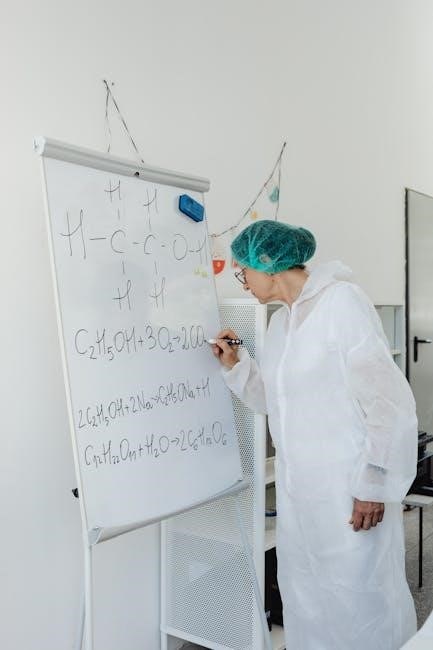
Next, identify all bonded atoms (‘B’) and lone pairs (‘E’) around the central atom. Apply the ABE notation (AXnEm) to categorize the electron arrangement. Use this notation to predict the electron pair geometry (linear, trigonal planar, tetrahedral, etc.).
Finally, consider the influence of lone pairs on the molecular shape. Lone pairs cause greater repulsion, distorting the ideal geometry. Compare your predicted shape with the answer key, and review any discrepancies.
Practice consistently with VSEPR worksheets, focusing on understanding why a particular shape is formed, not just memorizing answers.
Practice Problems and Answer Keys
Numerous VSEPR worksheets available in PDF format offer a wealth of practice problems, ranging from simple diatomic molecules to complex polyatomic ions. These problems typically require determining the Lewis structure, identifying electron groups, and predicting both electron pair and molecular geometries.
Crucially, most quality worksheets include detailed answer keys. These keys not only provide the correct shapes but often explain the reasoning behind them, referencing the VSEPR theory and the influence of lone pairs.
Utilizing these resources allows students to self-assess their understanding and pinpoint areas needing improvement. Working through a variety of examples – like those involving CO₂, NH₃, and H₂O – solidifies the application of the ABE notation and the prediction of bond angles.
Consistent practice with answer key verification is vital for mastering VSEPR concepts.
Advanced VSEPR Concepts (Beyond Basic Shapes)
While basic VSEPR theory covers common geometries, advanced concepts address complexities not easily solved with simple worksheets. These include molecules with multiple central atoms, resonance structures, and the impact of pi bonds on electron density.
Some VSEPR worksheets in PDF format begin to touch upon these nuances, presenting scenarios where the ideal bond angles deviate significantly due to steric strain or differing electronegativities.
Understanding hypervalent molecules (those exceeding the octet rule) and molecules exhibiting d-orbital hybridization requires extending the basic VSEPR model. These advanced topics often necessitate considering the influence of non-bonding interactions.

Furthermore, analyzing molecules with delocalized electrons demands a deeper understanding of resonance and its effect on molecular shape. Mastering these concepts builds upon the foundation established by introductory VSEPR practice.